Direct Answer
For most Tampa-area homes during cooling season, set the thermostat fan to Auto. Auto runs the indoor blower with the cooling cycle, then lets it stop so moisture on the coil can drain. On keeps air moving continuously and can return some coil moisture to the home, increasing humidity and fan energy use.
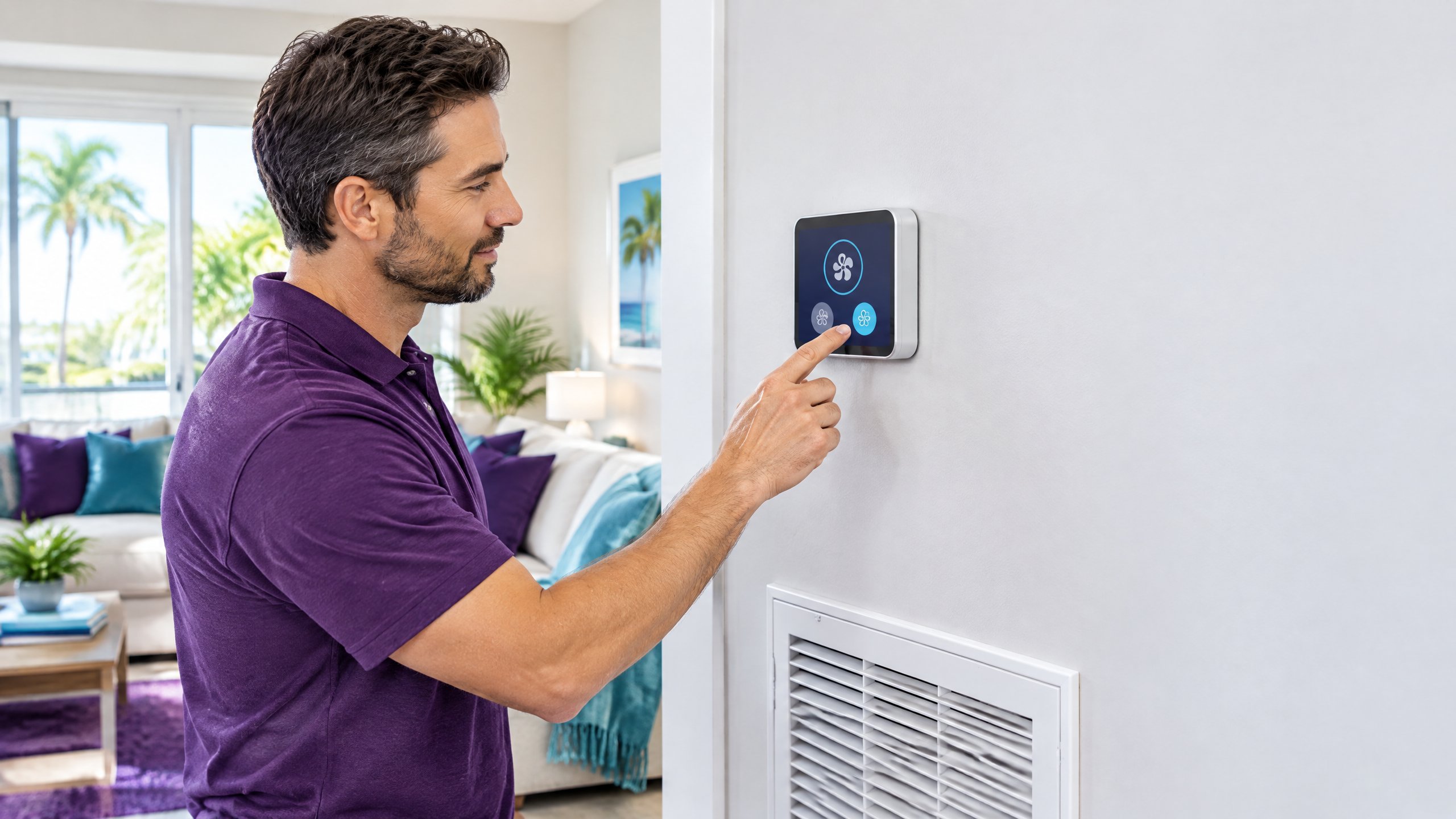
The fan control on a thermostat usually offers Auto and On. Those words describe the indoor blower, not whether the complete air conditioner is cooling. A system can move room-temperature air with the fan On even when the compressor is not operating.
In Tampa, Lutz, Odessa, Land O’ Lakes, Wesley Chapel, New Tampa, Zephyrhills, and Carrollwood, moisture control is part of the everyday cooling decision. A setting that keeps the blower running after the compressor stops can affect how much condensed moisture remains out of the living space.
What Auto and On Actually Mean
Auto tells the indoor blower to operate when the thermostat calls for cooling or heating. The blower normally stops when that cycle ends, although some systems have a short programmed delay or specialized controls.
On tells the blower to run continuously, whether or not the compressor is cooling. That can keep air mixed between rooms, but it also consumes blower energy and moves air across the indoor coil during compressor-off periods.
| Fan setting | Blower operation | Typical Tampa cooling-season effect |
|---|---|---|
| Auto | Runs with the cooling call, then stops | Usually supports moisture drainage and lower blower runtime |
| On | Runs continuously | Provides continuous air movement but can reintroduce coil moisture and use more fan energy |
| Circulate | Runs selected intervals, depending on the thermostat | May provide some air mixing without continuous operation; exact behavior varies |
Why Auto Is Usually Better for Tampa Humidity
During cooling, warm indoor air passes over a cold evaporator coil. Moisture condenses on the coil and drains toward the pan and condensate line. The U.S. Department of Energy’s Building America Solution Center describes residential air conditioning as both cooling and dehumidifying indoor air.[1]
When the compressor stops but the blower keeps running, air continues across the wet coil. Florida Solar Energy Center research explains that some retained moisture can evaporate back into the airstream during this off cycle. Its hot-humid-climate guidance recommends Auto rather than continuous On operation for conventional residential systems.[2]
Tampa Electric also includes the fan setting in its local cooling guidance and recommends Auto.[3] The practical reason is not that Auto creates more cooling. It lets the blower stop between calls, reducing continuous fan runtime and giving condensed water a better opportunity to leave through the drainage system.
Fan mode and temperature mode are separate
Cooling mode tells the system when to produce cooling. Fan mode tells the indoor blower when to move air. If the fan is On, air from the vents can continue after the outdoor unit stops.
When the On Setting May Be Useful
There are limited situations where continuous airflow may be intentional. A homeowner may use it briefly to mix temperatures after cooking, during a gathering, or while checking whether specific rooms receive airflow. Some filtration or ventilation designs may also use longer fan operation.
Those cases depend on the thermostat, blower, filter, equipment controls, and the purpose of the system. A variable-speed system or a thermostat with a dehumidification strategy may not behave like a basic single-stage unit. Follow the operating instructions for the installed equipment rather than assuming one control sequence fits every home.
If the goal is simply to feel more air movement in an occupied room, a ceiling fan can move air locally without running the central blower throughout the entire home. Turn room fans off when the room is unoccupied.
What If the Fan Keeps Running on Auto?
A brief delay after the compressor stops may be programmed into the equipment. Longer or unexpected operation can involve thermostat configuration, a fan relay, control wiring, a variable-speed sequence, or another equipment condition. The symptom needs context: note whether the outdoor unit is running, whether the air feels cool, and how long the blower continues.
If the thermostat does not respond to a fan-mode change, On The Way provides thermostat repair. If the blower runs but the home is not cooling, our focused guide explains what to check when the AC is running without cooling. A technician may need to test the control signal and complete cooling sequence rather than replace a thermostat based only on the display.
Four Checks a Homeowner Can Make
- Confirm both controls: Set the system mode to Cool and the fan to Auto. The temperature setpoint must be below the room temperature for a cooling call.
- Watch one complete cycle: Note when the outdoor unit stops and whether the indoor airflow stops soon afterward.
- Check the filter: Inspect an accessible filter and use the correct replacement size and type. On The Way also provides air filter replacement guidance and service.
- Record humidity and symptoms: Note whether the home feels damp, airflow is weak, ice appears, or the thermostat shows an alert.
A professional AC maintenance visit can include thermostat settings, blower components, system controls, filter condition, coils, and drainage. Tell the technician if the fan behaves differently after cooling ends or if indoor humidity changed after a thermostat adjustment.
Do not remove thermostat wiring, open electrical compartments, or change internal fan-speed settings. Those adjustments can affect equipment operation and should be based on the actual system design and measurements.
When Fan Mode Is Not the Whole Problem
Changing from On to Auto can remove one source of moisture re-evaporation, but it cannot correct every humidity complaint. Short cooling cycles, oversized equipment, drainage problems, weak airflow, moisture entering the home, and equipment configuration can also matter. Our broader guide explains why a Tampa home may feel humid even with the AC running.
If airflow is weak, the coil is icing, the fan ignores thermostat commands, or the home does not reach the set temperature, request AC repair. On The Way serves North Tampa homeowners with system-specific testing rather than diagnosing a failed component from fan behavior alone.
Frequently Asked Questions
Does setting the AC fan to On cool a Tampa home faster?
No. The On setting keeps the indoor blower moving air, but it does not make the compressor produce more cooling. It can make rooms feel more evenly mixed while the blower runs. If the home is not reaching the set temperature, check for a cooling or airflow problem rather than relying on continuous fan operation.
Why is my AC fan still running when the thermostat is set to Auto?
Some systems use a brief programmed fan delay, and variable-speed equipment may operate differently from a basic single-stage system. If the blower continues well after cooling stops, a thermostat setting, relay, control, wiring, or equipment condition may need diagnosis.
Is the Circulate setting the same as On?
Not usually. On commonly runs the blower continuously, while Circulate typically runs it for selected intervals each hour. Exact behavior depends on the thermostat and equipment controls. In a humid climate, monitor comfort and follow the operating guidance for the installed system.
Should I use Auto if my Tampa home still feels humid?
Auto is a useful first setting check because it lets the blower stop when the compressor stops. Persistent humidity can still involve short runtime, equipment sizing, drainage, airflow, building moisture, or system configuration, so changing fan mode may not resolve the complete cause.
Sources
- U.S. Department of Energy Building America Solution Center: Air Conditioning
- Florida Solar Energy Center: AC System Equipment and Operational Options for Improved Indoor Humidity Control
- Tampa Electric: Ways to Reduce Your Cooling Bill
Reviewed by a Local HVAC Owner
Dustin Miller, Owner of On The Way Heating & Air. Dustin began working in HVAC with his father in 2006 and has helped build several service companies. This article provides general homeowner guidance; the correct fan sequence depends on the thermostat, air handler, cooling equipment, accessories, and control configuration installed at the home.