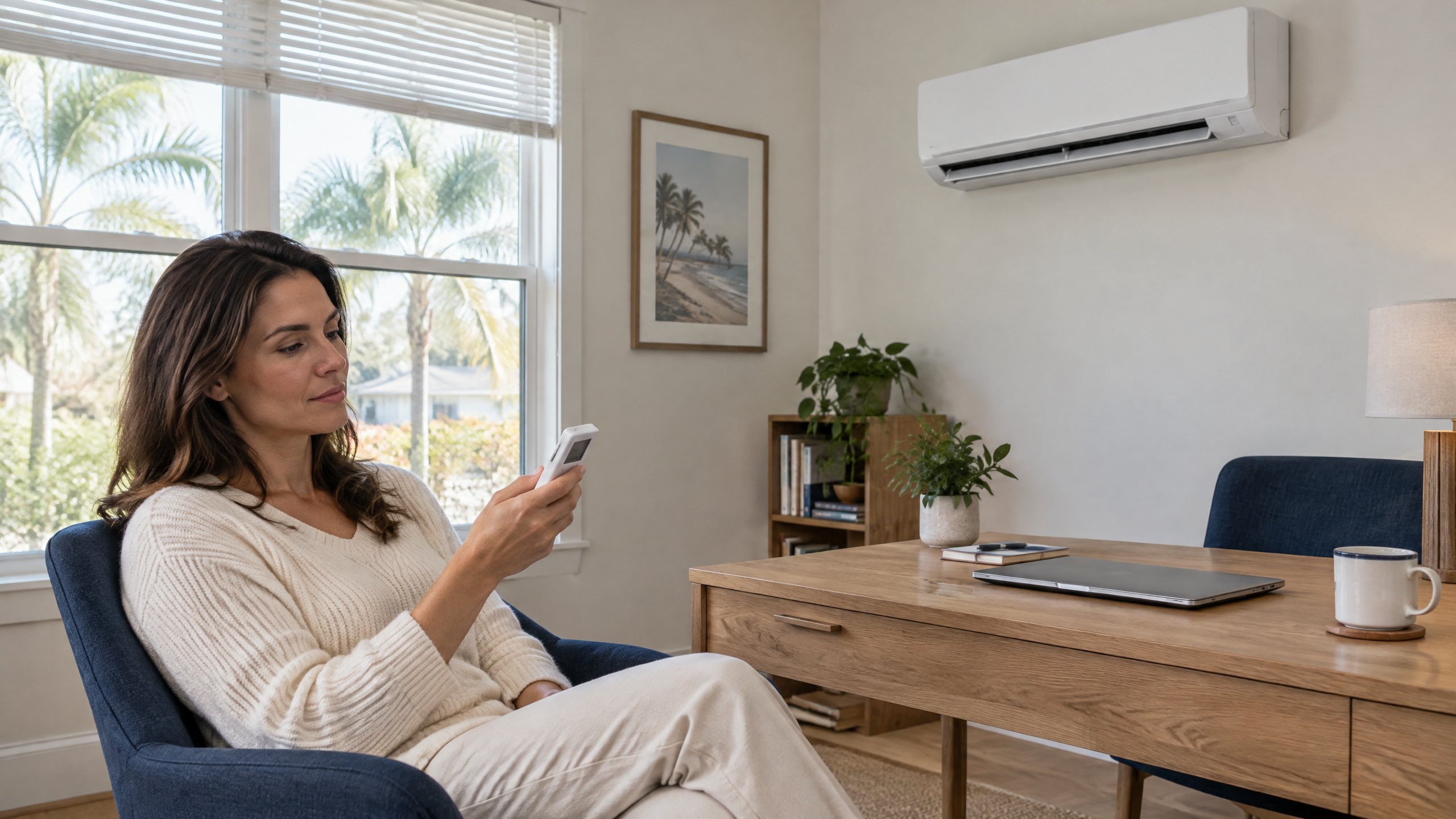
Cool Targets Temperature; Dry Targets Moisture
The two settings are not simply different names for the same job. In its operating-mode explanation, Daikin describes cooling as moving heat from indoors to outdoors to lower room temperature. It describes Dry as reducing airborne moisture through condensation. That distinction helps you choose the task, but does not describe every model's exact control sequence. [1]
Dry operation uses cooling inside the appliance to collect water from humid air. Do not read the word “Dry” as a promise that the room temperature will remain unchanged. The Mitsubishi Electric example below explicitly allows slight room cooling. Both the purpose and the actual operating instructions matter. [1] [3]
If you are choosing equipment for an addition rather than using an existing remote, start with our Mini Split versus duct-extension guide. A Dry button does not establish that a particular head has been selected to meet the room's complete cooling and moisture needs.
Why Your Temperature Buttons May Work Differently in Dry
For a concrete example, Mitsubishi Electric's MSZ-AS90VGD user manual describes Cool as cooling to your desired temperature. Its Dry instructions say the room may be cooled slightly and that temperature cannot be set during Dry mode. Those statements appear on printed page En-6. [3]
This is an Australia-hosted manual for one named indoor unit, not a specification for every Mitsubishi Electric product or every Mini Split sold in Florida. Your installed model may have different supported controls. Check its own operating manual before deciding that a button that does not change the Dry setting is broken.
Identify the indoor-unit model and the correct remote or controller instructions. Read the Dry section, including its temperature-adjustment notes and any operating limits. Do not borrow a fixed fan speed, runtime or temperature rule from another product's online tutorial. The cited example does not establish a universal Dry-mode fan speed or compressor cycling pattern.
Choose the Mode for the Room's Actual Problem
When the room is hotter than you want it, use the model's normal Cool operation to request a lower temperature. When temperature is already comfortable but the room feels damp, the supported Dry setting may be worth considering under the owner's instructions. Daikin makes this hot-versus-humid distinction in its guidance. Neither choice guarantees a particular humidity outcome. [1]
A mild, damp day in Tampa can make that distinction useful. The homeowner's question is not just “Which setting feels colder at the outlet?” It is whether the room needs cooling, moisture removal or both. If Dry makes the room uncomfortably cool without resolving the moisture concern, do not keep extending operation simply because the setting's name sounds appropriate.
There is no all-model schedule in this article for running Dry overnight or for a specified number of hours. Follow the installed equipment's instructions and observe the room. A recommended mode is an operating choice, not a substitute for investigating persistently unsatisfactory conditions.
Check Temperature and Humidity, Not Only the Remote
A mode label does not show how much moisture has actually left the room. EPA recommends measuring relative humidity with a humidity meter and addressing moisture sources when condensation appears. Use a room measurement alongside the room temperature rather than judging the result only by a cool breeze. [2]
Keep a short record of the mode, time, room temperature and humidity. Note whether windows were open or a moisture-producing activity had just occurred. Compare observations in the same location under reasonably similar use. These notes make the service conversation more specific; they are not a capacity test or a diagnosis from one reading.
The useful observation is whether the intended room remains comfortable and whether moisture concerns persist. Do not assume that a visible Dry indicator means the equipment has a selectable humidity target. Check whether your model's instructions actually describe one. Likewise, do not assume it controls every room in the home.
Dry Mode Is Not a Repair for Leaks or Changed Performance
Airborne moisture and liquid water escaping where it should not are different problems. EPA calls for fixing water problems and keeping air-conditioning drain lines unobstructed and flowing properly. Switching modes does not repair a roof leak, plumbing leak or condensate-drain fault. [2]
If water is dripping indoors from the head or nearby finishes, stop using the appliance and request assessment rather than continuing a Dry trial. If cooling has changed, a warning appears or expected operation does not recover after the owner's documented checks, arrange an AC repair assessment. The cited Mitsubishi manual also directs the user to stop using the air conditioner and consult the dealer when trouble does not recover after its checks. [3]
Report the model, selected mode and exact warning, along with what changed. Do not remove covers, change wiring, alter service settings or improvise drain work to force a result. The technician should distinguish a documented operating limitation from a control, cooling or drainage problem before recommending a repair.
When the Room Needs More Than a Mode Change
Persistent dampness calls for a moisture assessment, not an automatic recommendation to replace the Mini Split. EPA's guidance emphasizes correcting the water or moisture problem. Ask what sources remain and whether the installed equipment is operating as intended. [2]
For the separate appliance decision, our dehumidifier versus AC guide explains supplemental moisture control. A Dry setting alone does not establish that another appliance is unnecessary—or that one is needed. First define the affected space and the concern you want corrected.
Frequently Asked Questions
Why can't I change the temperature in Dry mode?
That can be a documented control limitation rather than a fault. Mitsubishi Electric's MSZ-AS90VGD manual specifically says temperature cannot be set in Dry. Check your own model; this example does not establish the behavior of every Mini Split.
Does Dry mode guarantee that the room will not get colder?
No. Dry operation uses cooling for condensation, and the cited Mitsubishi Electric manual says the room may be cooled slightly. Check your model's behavior and room conditions rather than treating Dry as temperature-neutral operation.
Is Dry mode always cheaper to run than Cool?
Do not assume that from the mode name. This article does not establish an energy-use comparison for your model and room. Choose the supported operation for the comfort task, and evaluate any operating-cost claim using relevant equipment data and conditions.
Should I switch to Dry if Cool has stopped working?
Not as a repair strategy. Record the model, controls and changed performance, follow the owner's documented checks and request assessment if expected operation does not recover. A different mode does not identify or correct the failed condition.
Editorial Source Review & Publisher
Published by On The Way Heating & Air. This local, family-rooted company uses manufacturer operating guidance and federal moisture advice to explain a narrow control question. The article is not an inspection, equipment endorsement, all-model operating specification or promised humidity result. Use the installed model's instructions and seek assessment for changed performance or indoor water leakage.
Sources
- Daikin — What's the Difference Between Cooling and Dry Mode? Temperature versus moisture tasks and condensation; not a specification for every model or a savings promise.
- EPA — A Brief Guide to Mold, Moisture and Your Home. Humidity measurement, water-source correction and functioning condensate drainage.
- Mitsubishi Electric — MSZ-AS90VGD User Operating Instructions, JG79Y723H02. Printed En-6: specific Cool/Dry purposes, possible slight cooling and no temperature setting in Dry; En-14: unresolved trouble referral. Australia-hosted model example, not every Florida unit's controls.