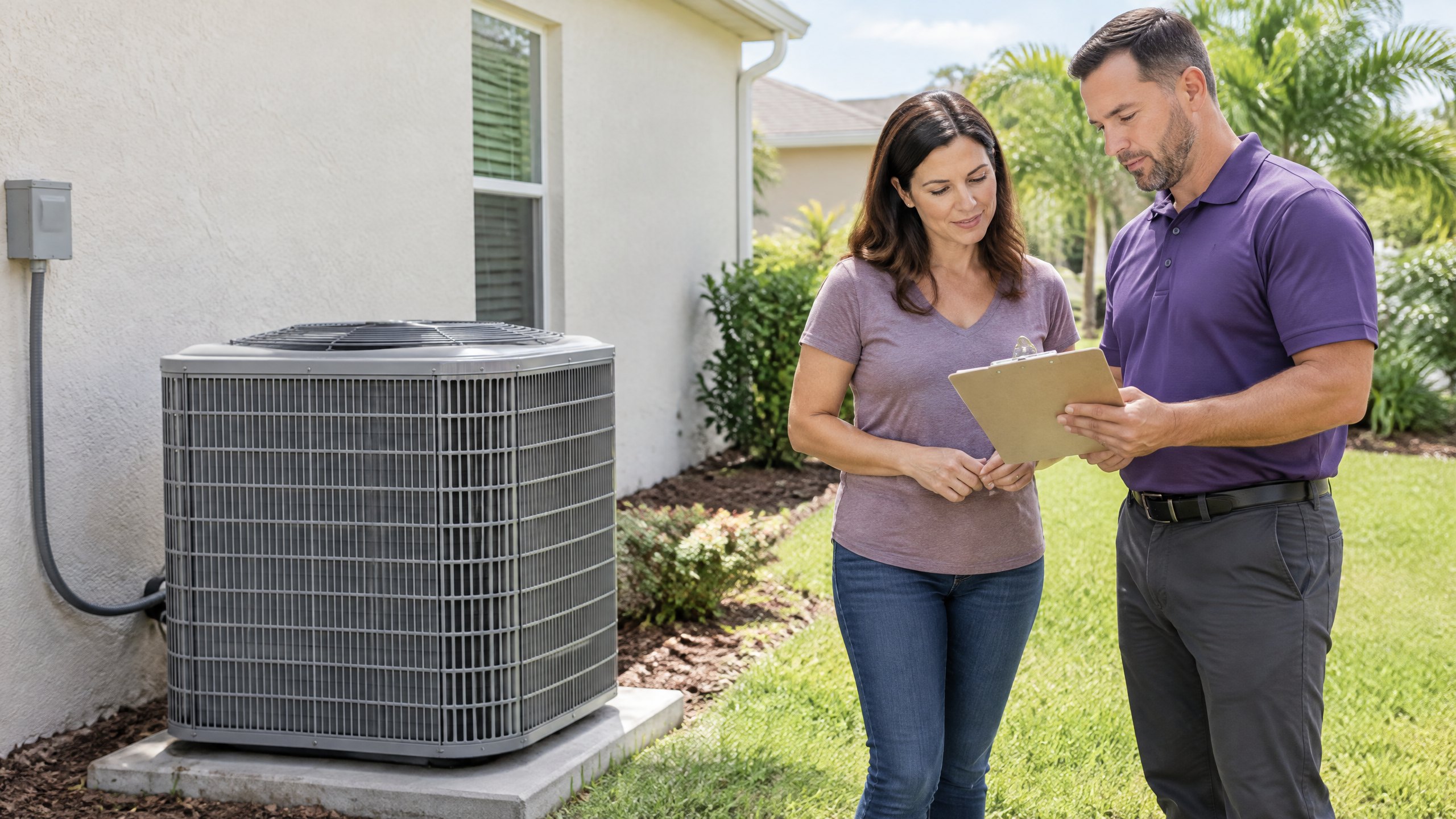
If the outside unit fails while the indoor blower still runs, keeping the indoor equipment can sound like an obvious way to limit the project. But a split-system air conditioner is one connected refrigeration system. The real question is whether the proposed outdoor unit can work with the exact indoor equipment you would retain—not whether both cabinets have the same brand name.
What Does “Outdoor Unit Only” Actually Mean?
In a typical split AC, the outdoor assembly contains the compressor and condenser coil. The indoor equipment includes the evaporator coil, blower, and a refrigerant-metering device. Refrigerant piping connects the two sides. PNNL’s Building America guidance explains this shared cooling circuit. [2] Replacing the outdoor assembly is different from replacing a compressor inside the existing assembly.
Ask the contractor to name every item being replaced and retained. “New AC” could describe a complete matched system, an outdoor unit with an indoor-coil change, or an outside-only proposal. Those are different scopes. If the diagnosis is specifically compressor failure, start with our compressor replacement decision article rather than assuming the entire outdoor unit must go.
Why Same Brand or Same Tonnage Is Not Enough
AHRI explains that split-system indoor and outdoor equipment must be properly matched to deliver the expected efficiency and longevity. Its reference number or certificate identifies a certified combination—not an approval for every indoor unit sharing the outdoor unit’s brand. [1]
PNNL notes that certified combinations can depend on the outdoor model, indoor unit, indoor coil, and fan type. [2] Similar cabinet size or nominal tonnage is not proof of a match. Ask for the exact model numbers of the proposed outdoor equipment and the retained indoor coil and air handler, along with the documentation supporting that combination.
Also ask how the manufacturer’s installation instructions address refrigerant, the metering device, controls, and required airflow. A match certificate documents rated performance; it does not replace inspection of your existing equipment or verification of the completed installation.
Can Partial Replacement Ever Be Considered?
A limited replacement deserves evaluation when the failure is isolated, the retained equipment is in serviceable condition, and the contractor can document the proposed combination and applicable installation requirements. None of those conditions can be confirmed from an outside photo or a telephone description. A recently replaced indoor unit is worth identifying, but its age alone does not establish compatibility.
EPA’s homeowner FAQ gives a conditional condensing-unit replacement example for existing HCFC-22 systems, subject to efficiency requirements. [4] That refrigerant-specific example is not blanket permission for every system or proof that an appropriate replacement is available. Have the contractor verify the requirements for your exact equipment and project; do not assume a new refrigerant can simply be substituted.
There is also a reason to compare both sides together: PNNL’s retrofit guidance recommends replacing indoor and outdoor units together for the highest efficiency and best performance. [2] An outside-only proposal should explain why retaining the indoor side is suitable in your case, rather than presenting partial replacement as automatically equivalent to a complete-system installation.
What Should Be Checked Before Keeping the Indoor Side?
The indoor blower running only shows that it can move some air. It does not rule out an indoor-coil leak, airflow restriction, drainage problem, or unsuitable equipment combination. Request findings on the retained coil, blower, controls, drainage, and relevant ducts. Tell the technician about recurring moisture, uneven room temperatures, and previous refrigerant work.
ENERGY STAR’s quality-installation guidance emphasizes correct sizing, manufacturer-specified airflow, refrigerant-charge testing, and duct evaluation. [3] Those needs remain relevant even when only the outdoor assembly changes. An AC repair assessment can establish the failure and remaining equipment condition before you compare replacement options.
For a Tampa or North Tampa home, moisture control belongs in that discussion. A new outdoor cabinet is not a promise to resolve humidity or room-to-room comfort problems. If those complaints already existed, ask which findings the proposal addresses and which remain outside its scope.
Which Documents Make an Outside-Only Quote Useful?
A useful partial-replacement proposal should let you answer these questions without guessing:
- What failed, and what findings support replacing the outdoor assembly rather than repairing a component?
- Which indoor model and coil will stay, and what documentation supports the proposed combination?
- What is included for refrigerant piping, controls, electrical connections, drainage, and startup checks?
- What written warranty applies to the new equipment and work, and what remains unchanged on retained equipment?
- Who verifies applicable permit, inspection, and installation requirements for this project?
If an advertised efficiency rating is used, request the rating for the actual combination with the retained indoor side. Our SEER2 guide explains why an outdoor brochure alone is not enough. Use the broader replacement quote checklist for a complete-system comparison, not as evidence that your old indoor unit is approved.
How Should You Compare Partial and Complete Replacement?
Compare two clearly described scopes, not simply “cheap” and “expensive” options. The outside-only choice retains the indoor equipment’s existing condition and limitations. A complete-system option changes more equipment, but still needs proper sizing and installation. Neither option promises a specific lifespan or utility bill.
Ask what would happen if the retained indoor coil later needed replacement: would a compatible repair option be available, and what additional work would be required? Ask the contractor to distinguish known findings from uncertain future costs. For a broader option, an AC installation consultation can explain the complete matched-system scope alongside the documented partial proposal.
Do not disconnect refrigerant lines, open electrical compartments, or attempt a refrigerant conversion to make equipment fit. This is an equipment-selection and professional-installation decision, not a homeowner trial-and-error repair.
Frequently Asked Questions
Can I keep my air handler if only the outdoor AC unit failed?
Possibly, but the exact indoor equipment must be evaluated and the proposed outdoor combination documented. A running blower or recent indoor replacement is not proof of compatibility. Compare the retained equipment’s condition and limitations with a complete matched-system option.
Does buying the same brand guarantee an indoor-outdoor match?
No. Compatibility and certified performance depend on exact equipment combinations, not just the brand name. Request the indoor and outdoor model numbers and the AHRI reference or certificate supporting the proposed combination.
Will a new outdoor unit give my old air handler the advertised SEER2?
Do not assume that. Ask for the certified rating of the actual combination with the retained indoor equipment. An outdoor-unit brochure does not establish the installed system’s rating or guarantee a particular electric bill.
Is replacing the outdoor unit the same as replacing the compressor?
No. Compressor replacement repairs a component within the existing outdoor assembly. Outdoor-unit replacement changes the assembly and requires evaluation of its combination with the indoor equipment. Compare the confirmed diagnosis and written scope before choosing either option.
Sources
- AHRI — Air Conditioners and Heat Pumps. General matched-system documentation; historical minimum-rating statements are not used here.
- PNNL / DOE Building America Solution Center — Air Conditioning. Connected components, certified combinations, installation, and retrofit recommendations.
- ENERGY STAR — HVAC Quality Installation. Sizing, airflow, charge verification, and ducts.
- EPA — Homeowners and Consumers: Frequently Asked Questions. Conditional HCFC-22 service example; not universal equipment approval.
Editorial Source Review & Publisher
Published by On The Way Heating & Air for Tampa and North Tampa homeowners. This educational article uses the sources above; it is not a diagnosis, equipment approval, or project-specific compliance determination. Request inspection and a documented proposal before authorizing work.