Quick Answer
A full central air-conditioner or Heat Pump replacement in Tampa or North Tampa generally requires a mechanical permit and a final inspection. The exact process depends on whether the property is inside the City of Tampa, in unincorporated Hillsborough County, in Pasco County, or under another local authority. Minor part replacements may be exempt, but a complete equipment change-out is not the same as a minor repair.
Permits are easy to overlook when the house is hot and the immediate goal is restoring cooling. Still, the permit record matters. It creates an official inspection step, helps document the equipment installed at the property, and gives the local building authority an opportunity to verify code-related items.
For Tampa-area homeowners, the important question is not simply, “Does AC work need a permit?” It is, “Which jurisdiction controls my address, what documents apply to this replacement, and who is responsible for closing the permit?” This guide explains the practical 2026 requirements using official City of Tampa, Hillsborough County, Pasco County, Florida Building Commission, ENERGY STAR, and EPA sources.
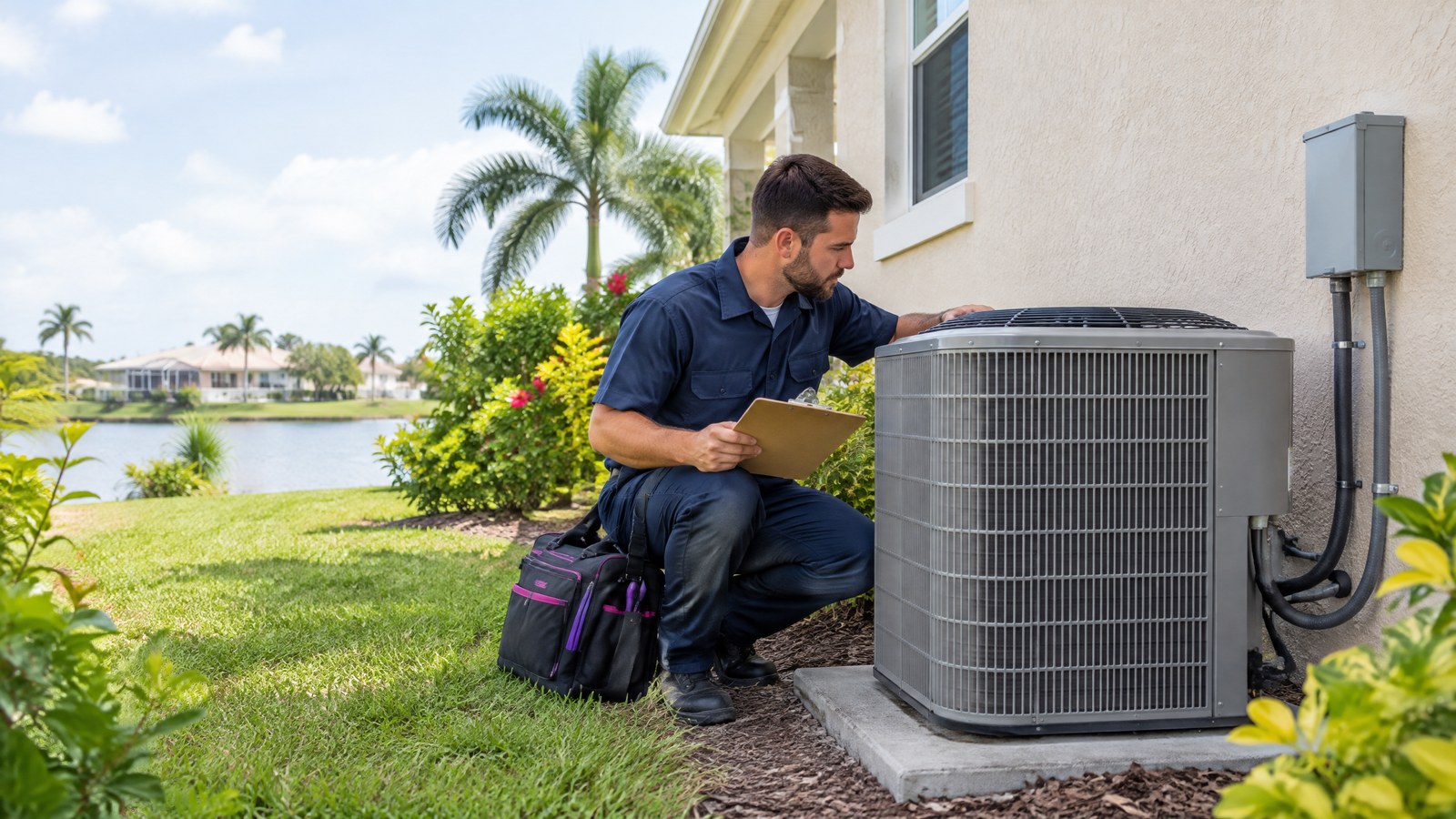
First, Identify the Authority for Your Address
A “Tampa” mailing address does not always mean the City of Tampa issues the permit. Homes throughout North Tampa may fall under the City of Tampa, unincorporated Hillsborough County, Pasco County, or a nearby municipality. The contractor should verify the authority having jurisdiction before quoting the permit process.
| Property location | Official starting point | What the official source shows |
|---|---|---|
| Inside City of Tampa limits | Tampa Construction Services | Residential mechanical permits include a Mechanical Final inspection. The City FAQ identifies an A/C change-out as an Express Permit project.[1] |
| Unincorporated Hillsborough County | HillsGovHub permit resources | The published mechanical exemptions cover portable equipment and minor replacement parts, not replacement of mechanical equipment.[2] |
| Pasco County | Pasco County permit packages | Pasco publishes a dedicated residential Air Conditioning permit package and directs applications through PascoGateway.[3] |
Do not rely on the mailing city alone. Ask the contractor to put the permit authority and permit responsibility in the written proposal.
What a Tampa AC Replacement Permit Helps Verify
The permit is not a substitute for choosing a qualified contractor, but it adds a formal review and inspection record. The City of Tampa states that permitted work must receive final inspection approval. Its residential mechanical page lists a Mechanical Final inspection for this category of work.[1]
Depending on the project and jurisdiction, the permit file may address the contractor, job scope, equipment information, code forms, sizing documentation, energy-efficiency information, electrical or structural details, and final inspection. Requirements can change, so the contractor should use the current package for the specific address.
Your written AC replacement proposal should state who will obtain the permit, whether the fee is included, who schedules the inspection, and who corrects any issue if the inspection does not pass the first time.
Florida Requires Proper Equipment Sizing
The Florida Building Commission explains that total residential HVAC replacement requires sizing calculations at permit time. Those calculations consider the home rather than simply copying the tonnage printed on the old equipment.[4]
ENERGY STAR likewise advises homeowners to expect a home evaluation and says the contractor should consider the house size, insulation, windows, duct condition, and airflow. It specifically warns that a bigger system is not automatically better.[5]
This is especially important in Tampa’s hot, humid climate. An oversized unit may satisfy the thermostat quickly without operating long enough to manage moisture as effectively as a correctly selected system. A replacement recommendation should explain the proposed capacity and the conditions used to determine it.
Questions to ask about sizing
| Question | Why it matters |
|---|---|
| What calculation or approved method supports this capacity? | Shows whether the recommendation reflects the home rather than a rule of thumb. |
| Were additions, windows, insulation, and air leakage considered? | Changes to the house can change the cooling load. |
| Was the existing duct system evaluated? | A new unit cannot deliver its rated performance through restricted or leaking ducts. |
| Why is the proposed tonnage different from the old unit? | Any capacity change should have a documented reason. |
The Indoor and Outdoor Equipment Must Be Matched
The Florida Building Commission states that the indoor and outdoor components need to be matched for their refrigerant and design conditions. They do not necessarily have to share a manufacturer, but their compatibility and rated performance must be documented.[4]
Ask the proposal to identify the outdoor unit, air handler or furnace, and evaporator coil by exact model number. Also ask for the AHRI reference number or another accepted matching document. This prevents a vague proposal from becoming an improvised equipment combination during installation.
If only one major component is being replaced, compatibility still matters. A partial replacement should not be treated as a simple swap without confirming that the remaining equipment can operate correctly with the new component.
Accessible Duct Connections Are Part of the Review
For a total residential HVAC replacement, the Florida Building Commission says the contractor must certify minimum equipment efficiency and inspect accessible duct joints and seams, sealing those that visibly need it.[4] This does not mean every replacement requires a complete duct-system renovation, and it does not authorize selling unrelated work. It does mean accessible connections should not be ignored.
If the evaluation identifies leakage or a disconnected joint, ask for a written explanation. On The Way offers duct repair and duct sealing when those services are actually warranted.
When Is a Notice of Commencement Required?
Hillsborough County publishes a specific threshold for mechanical-only projects: a Notice of Commencement is required when the repair or replacement of an existing heating or air-conditioning system costs $15,000 or more.[6]
That threshold should not be confused with the mechanical permit itself. A project can require a permit even when it falls below the Notice of Commencement threshold. If the project reaches the threshold, the County instructs homeowners to record and certify the notice with the Clerk before uploading it through HillsGovHub.
Other jurisdictions may use different procedures. Ask which documents apply to the property before work begins.
What Changed With Refrigerants in 2026?
Many homeowners have heard that older refrigerants were “banned” or that every new system had to change on a single date. The current rule is more specific.
EPA’s May 2026 final rule removed the January 1, 2026 installation deadline for qualifying higher-global-warming-potential residential and light-commercial air-conditioning equipment that had been manufactured or imported before January 1, 2025. EPA says qualifying pre-2025 inventory may continue to be installed until that inventory runs out.[7]
That means an R-410A system is not automatically illegal to install merely because the calendar says 2026. At the same time, newer lower-GWP equipment is increasingly common and may use refrigerants such as R-32 or R-454B. The proposal should identify the refrigerant, exact model numbers, manufacture information when relevant, and the service implications of that equipment choice.
Useful question: “Which refrigerant does this system use, when was the equipment manufactured, and how does the current EPA rule apply to this exact model?”
What Happens in an Emergency Replacement?
Florida heat can make a failed system urgent, but urgency does not erase the permit process. Hillsborough County states that when qualifying emergency equipment replacement or repair must be performed immediately, the permit application may be submitted on the next working business day. The City of Tampa publishes a similar next-working-day provision for emergency repairs.[2] [8]
If emergency work begins before the permit is issued, ask the contractor to provide the application or permit number promptly and confirm the inspection plan. “It was an emergency” should not become an excuse for leaving the job unpermitted or uninspected.
Homeowner Checklist Before Installation
Before authorizing a replacement, confirm the following items in writing.
| Checklist item | Confirmed? |
|---|---|
| The contractor identified the correct permitting jurisdiction for the address. | ☐ |
| The proposal states who obtains and pays for the permit. | ☐ |
| Exact indoor, outdoor, and coil model numbers are listed. | ☐ |
| The proposed equipment match and rated performance are documented. | ☐ |
| The contractor explained how system capacity was determined. | ☐ |
| Any required Notice of Commencement responsibility is identified. | ☐ |
| The refrigerant type and current-rule implications are explained. | ☐ |
| Final inspection scheduling and correction responsibility are written. | ☐ |
| The contractor’s Florida license has been verified. | ☐ |
| You will receive the permit and final inspection record. | ☐ |
After Installation: Verify the Permit Was Closed
Do not stop at “the contractor pulled a permit.” Ask for the permit number, confirm the equipment was inspected, and keep the final approval with the equipment model numbers, AHRI certificate, warranties, invoice, and maintenance records.
An open or failed permit can become a problem later when selling the property, processing another permitted project, or documenting installation history. Pasco County warns that unpermitted work can result in violations, additional fees, and after-the-fact permitting requirements.[3]
A Local, Family-Rooted Approach to AC Replacement
On The Way Heating & Air is locally owned and family rooted. Dustin Miller entered the HVAC trade with his father in 2006 and has helped build several service companies since then. Our role is to explain what the home requires, document the equipment and scope, and make the permit responsibility clear before installation begins.
That gives North Tampa homeowners a locally accountable alternative to private-equity-backed or distant regional operators. Ownership structure alone does not determine installation quality, so every homeowner should still compare the written scope, permit responsibility, equipment, warranty, and person responsible after the job is complete.
Complete systems start at $8,000 and increase based on the home’s needs, installation conditions, capacity, efficiency, equipment, and the homeowner’s preferences. If you are considering AC installation in Tampa, Lutz, Odessa, Wesley Chapel, Land O’ Lakes, New Tampa, Zephyrhills, Carrollwood, or nearby North Tampa communities, call (813) 922-2209 or request an estimate online.
Frequently Asked Questions
Do I need a permit to replace a central AC system in Tampa?
A full central AC or Heat Pump change-out generally uses a mechanical permit. The City of Tampa identifies A/C change-outs as Express Permit projects and requires a Mechanical Final inspection. Hillsborough County exempts portable equipment and minor replacement parts, not replacement of mechanical equipment. Requirements depend on the property’s jurisdiction.[1] [2]
Who should obtain the AC replacement permit?
The written proposal should identify the licensed contractor responsible for the permit, permit fee, required documents, inspection scheduling, and correction of any failed inspection. Homeowners should verify the permit record with the authority having jurisdiction.
When does Hillsborough County require a Notice of Commencement for AC work?
Hillsborough County states that a Notice of Commencement is required when a mechanical-only project repairing or replacing an existing heating or air-conditioning system costs $15,000 or more. This threshold is separate from the mechanical permit requirement.[6]
Is R-410A equipment illegal to install in 2026?
Not categorically. EPA revised its Technology Transitions rule in May 2026 to allow qualifying higher-GWP residential and light-commercial AC equipment manufactured or imported before January 1, 2025, to be installed until that inventory runs out.[7]
Does an emergency AC replacement still need a permit?
Hillsborough County and the City of Tampa state that when qualifying emergency equipment work must be performed immediately, the permit application may be submitted by the next working business day. Emergency timing does not eliminate the permit requirement.[2] [8]
Sources
- City of Tampa: Residential Electrical, Plumbing, and Mechanical Permits
- Hillsborough County: Work Exempt From Permits
- Pasco County: Residential Air Conditioning Permit Package
- Florida Building Commission: Air-Conditioning Replacement Questions and Answers
- ENERGY STAR: 10 Tips for Hiring a Heating and Cooling Contractor
- Hillsborough County: Building and Subtrade Permit Resources
- U.S. EPA: Regulatory Actions for Technology Transitions
- City of Tampa: Construction Services FAQ